OS Distros
Operating systems was one of my favorite classes at school, but I realized I didn’t know much about them in the real world — what distros are out there, how they differ, and why you’d pick one over another. Whenever I use the cloud or spin up VMs, I see familiar options like Ubuntu and RHEL, but I usually just choose the default without thinking too much about it. So I decided to take some time to learn the history of operating systems, and where today’s popular distros originate from.
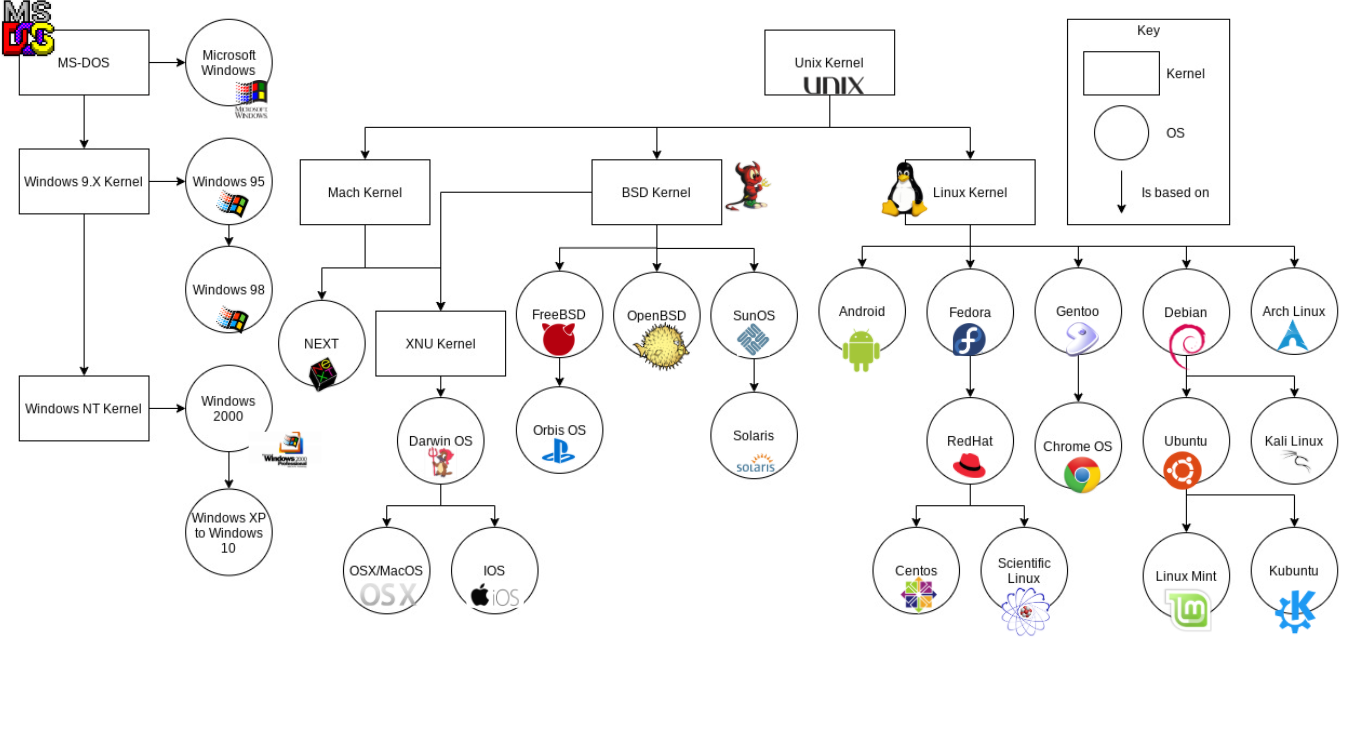
- Image Credit: OS Family Tree
Where It Started: Unix
Section titled “Where It Started: Unix”Unix is the “father” of modern operating systems. Developed by Ken Thompson, Dennis Ritchie, and others at AT&T Bell Labs starting in 1969, Unix stood out because it was written largely in C (as opposed to machine instructions), making it much more portable across different hardware platforms. While Unix was licensed by AT&T and wasn’t open-source in today’s sense, it was widely used in universities and research labs. This led to major extensions and improvements, most notably BSD.
BSD (Berkeley Software Distribution) was developed and distributed by the Computer Systems Research Group (CSRG) at UC Berkeley starting in 1978. Over time, BSD grew into an operating system in its own right, gradually replacing much of the original AT&T Unix code. While the original BSD project was eventually discontinued, open-source descendants like FreeBSD and OpenBSD are still active today.
FreeBSD became an integral part of other systems; for example, Apple’s Darwin and Sony’s PlayStation OS is based on FreeBSD. It’s also still widely used in production; a notable example is Netflix’s Open Connect, which runs on FreeBSD. OpenBSD emphasizes security, and it’s best known for OpenSSH, the widely used SSH implementation. You don’t need OpenBSD to use OpenSSH (OpenSSH runs on basically any OS), but OpenBSD is a common choice if security is the highest priority.
The original Bell Labs’ Unix isn’t maintained as one living project anymore, but Linux distros, the BSD family, and Darwin/macOS are often called “Unix-like”. Unix-like systems tend to adhere to POSIX standards, which means a lot of the system APIs and command-line conventions are the same. They also share features like a hierarchical filesystem rooted at /, a multi-user permissions model (users/groups + rwx bits), spawning shell commands as processes, and composing tools by piping output between commands (e.g., grep | sort | uniq).
GNU and the Birth of Linux
Section titled “GNU and the Birth of Linux”The GNU Project was started by Richard Stallman in 1983 while he was at MIT to build a free, Unix-compatible software ecosystem. Its name, “GNU’s Not Unix”, is a recursive acronym that makes a statement: Unix-like in behavior, but not constrained by AT&T’s licensing. GNU produced a large collection of user-space tools that could replace Unix programs, including compilers (GCC), libraries (glibc), core utilities (coreutils), and staples like Emacs and Bash. However, GNU on its own wasn’t a complete, runnable operating system, because it didn’t include the kernel, the piece that talks to the hardware and manages low-level resources.
- Fun fact: gnu is also another name for the African wildebeest, which is why the GNU project uses a gnu (often mistaken for a bison) as its logo.
In 1991, Linus Torvalds began writing the Linux kernel as a personal hobby project. Over time, Linux grew into one of the most influential open-source projects, powering a huge share of modern server and cloud infrastructure. Linux filled the missing piece that GNU didn’t have, the kernel. Together, the Linux kernel and GNU’s tools and libraries formed a complete, runnable system. Strictly speaking, Linux refers to the kernel, but in everyday conversation people often say “Linux” to mean the whole Linux-based OS distribution (often “GNU/Linux”).
Linux Distros
Section titled “Linux Distros”Over time, many “distros” (distributions) were built around the Linux kernel and GNU. A distro is a complete OS bundle that makes Linux usable day-to-day. It includes extra pieces like a package manager with official software repositories (e.g., apt, dnf), an installer to set up Linux on a machine or VM, and a service manager that starts and supervises background services (most commonly systemd).
While there are many Linux distros today, two families have become especially mainstream: the Fedora/Red Hat family and the Debian Family.
The Fedora/Red Hat family took shape in the early 2000s. It’s parent company, Red Hat’s business model is to build open-source software and make money by providing long-term maintenance and support for companies. In this ecosystem, Fedora ships newer technology first, while RHEL (Red Hat Enterprise Linux) is the more conservative, long-supported release used in enterprise environments. CentOS Stream sits between them, tracking what will eventually become the next RHEL updates. Companies like Meta are known to use CentOS Stream; CentOS Stream lets them run something very close to RHEL while also seeing changes earlier and contributing patches upstream so those improvements become part of the shared ecosystem.
Debian is another influential Linux distro, started in 1993 by Ian Murdock, and it’s one of the oldest distributions still actively maintained today. Ubuntu is derived from Debian and is developed/maintained by Canonical; it has become one of the most widely used Debian-based distros.
RHEL and Ubuntu are two of the most common Linux choices for servers and cloud VMs, but they have different priorities. RHEL is a strong pick when you want maximum stability over time, plus official vendor support - things big companies often care about for production systems. Ubuntu is a great default when you want something easy to use and flexible; for many projects and smaller teams, it’s more than enough.
- Fun fact: Debian was named after Ian Murdock and his then-girlfriend, Debra. Ubuntu is named after a South African philosophy/value that roughly translates to “humanity to others,” or “I am who I am because of who we all are.”
Microsoft Windows
Section titled “Microsoft Windows”While the systems we’ve talked about so far trace back to Unix, there’s another mainstream lineage: Microsoft Windows. Windows’ early roots go back to MS-DOS, which originated as 86-DOS (created by Tim Paterson) and was later acquired by Microsoft. Over time, Windows went on to dominate personal computers and enterprise desktops.
Even though Windows isn’t “Unix-like” and evolved along a very different path, Microsoft introduced WSL (Windows Subsystem for Linux) in 2016, which lets you use a Linux environment inside Windows without needing to dual-boot or spin up a VM.
While the OS family tree is huge and my knowledge is shallow to understand where each one shines, I feel much more grounded in the operating systems world after writing this post. An OS is arguably one of the most sophisticated pieces of software ever built, and researching its history made me appreciate the open-source efforts that have accumulated over decades. Operating systems will keep evolving as hardware gets more powerful and computing spreads to everything from servers to IoT devices, so I’m excited to see what comes next.